 AI
Development
AI
Development
 Shopify
 Magento Open Source
 Adobe Commerce
 WordPress
 B2B Excellence





Google Ads AI Max: What It Is and How It Can Impact Your Business


Google Ads AI Max is a feature suite inside Search campaigns that uses Google’s AI to expand search term matching, generate ad assets and route clicks to the most relevant landing page. Launched in global beta in May 2025, it is not a new campaign type, it is an optional layer of automation you enable on an existing Search campaign.
What Does Google Ads AI Max Actually Do?
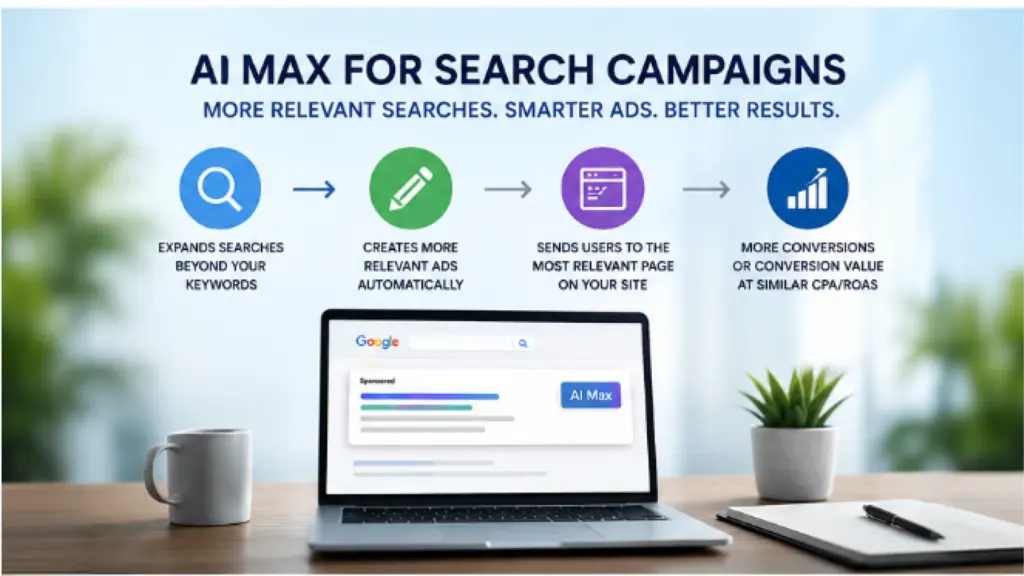
Google Ads AI Max has three main components.
1. How Does AI Max Search Term Matching Work?
AI Max expands beyond your existing keywords using broad match and keywordless technology. Google uses signals from your keywords, creative assets and URLs to identify relevant searches you may otherwise miss.
For ecommerce advertisers, this could mean appearing for a longer, more conversational search that would never have been added manually to the account.
2. What Does AI Max Asset Optimisation Do?
AI Max includes text customisation, formerly known as automatically created assets. It can generate headlines and descriptions using information from your ads, keywords and landing pages.
It can also use Final URL Expansion to direct users to a more relevant page on your website.
However, this is where campaign management still matters. Before enabling URL expansion, advertisers should review their site and exclude pages that are outdated, irrelevant or unsuitable for paid traffic.
3. What Controls and Reporting Does AI Max Add?
AI Max adds several controls, including:
- Locations of interest at ad group level
- Brand controls at campaign and ad group level
- URL parameters for greater query visibility
- Improved asset reporting
- Asset removal controls
- URL controls
These features give advertisers more ways to manage expansion rather than simply handing everything to automation.
Is Performance Max Being Replaced by AI Max?
No. AI Max does not replace Performance Max. AI Max is a feature suite within Search campaigns, while Performance Max remains a separate campaign type that can run across Search, Display, YouTube, Discover, Gmail and Maps.
The two products increasingly share similar AI-driven principles. Both can use broader and keywordless matching logic, and Google is improving reporting across Search and Performance Max.
However, they solve different problems.
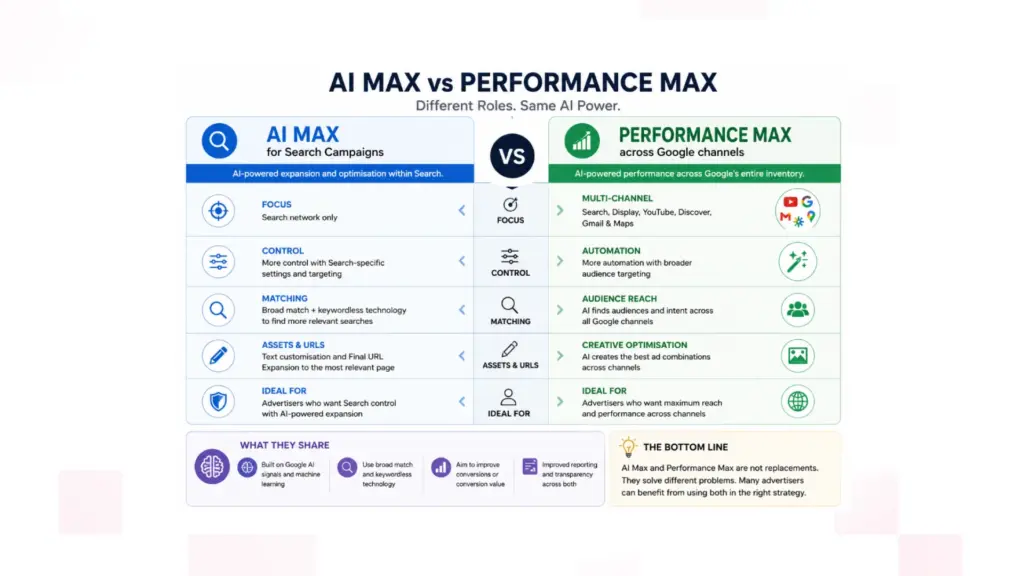
AI Max for Search campaigns is designed for advertisers who want Search-focused activity with additional AI-powered expansion and controls.
Performance Max is designed to automate performance across Google’s wider advertising ecosystem.
Therefore, the real story behind Performance Max vs AI Max is not replacement. It is the increasing use of AI across different campaign types.
What Results Has AI Max Produced?
According to Google’s AI Max announcement in May 2025, advertisers who activated AI Max typically saw 14% more conversions or conversion value at a similar CPA or ROAS. (Source: Google Ads & Commerce Blog, May 2025.)
Google reported a higher typical uplift of 27% for a narrower group: non-retail Search campaigns where more than 70% of conversions or conversion value already came from exact or phrase match keywords.
Google published two named case studies alongside the launch.
- L’Oréal reported a 2x lift in conversions and a 31% fall in cost per conversion after adopting AI Max to surface new search opportunities and improve ad relevance
- MyConnect, an Australian utility connection service, reported 16% more leads at a 13% lower cost per action, plus a 30% increase in conversions from net-new queries.
These figures are useful benchmarks, but they are Google-reported case study numbers rather than independently audited results. Treat them as a directional signal and validate against your own account data before committing budget.
How Do You Set Up Google Ads AI Max?
The setup itself may be straightforward. The preparation is where the real work begins.
Which Campaign Should You Enable AI Max On First?
Rather than enabling AI Max across an entire account, begin with a Search campaign that has:
- Accurate conversion tracking
- A clear CPA or ROAS target
- Enough historical data to establish a baseline
- Relevant and well-maintained landing pages
This makes it easier to identify whether AI Max is genuinely producing incremental value.
What Should You Check Before Turning on AI Max?
Before activating broader expansion:
- Check locations of interest if geographical intent matters to your campaigns.
- Set brand controls to manage brand associations.
- Review generated text assets and remove anything that does not meet your brand or commercial requirements.
- Set URL controls and exclusions before enabling Final URL Expansion.
- Monitor search term reporting to understand the quality of newly discovered queries.
What Does AI Max Mean for UK Ecommerce Advertisers?
Keyword research won’t disappear, but it is changing in importance for UK advertisers when using AI Max.
Keywords will increasingly serve as anchor points rather than rigidly defining the searches your campaigns can reach.
Budget allocation should be considered carefully too. Maxing out traffic isn’t necessarily going to improve your performance. Those looking to advertise ecommerce products should pay particular attention to conversion value, ROAS, landing page performance and whether extra spend is bringing profitable growth.
Brand safety also requires closer attention. Broader matching can uncover valuable new demand, but it can also introduce search contexts you would not have deliberately targeted.
The strongest AI Max accounts will not be the ones with the least human involvement. They will be the ones where automation is supported by clean data, strong website architecture and regular performance reviews.
What Are the Risks of Using Google Ads AI Max?
AI Max carries three trade-offs: reduced keyword-level control, brand safety exposure from keywordless expansion, and a heavier search term review workload. The cost is management attention, not licence fees.
You give up some of the detailed keyword-level controls you get with regular Search campaign management. Automated broad and keywordless expansion can also lead to brand safety issues if you don’t configure controls properly.
Search term reports still need monitoring. Look for irrelevant themes, poor-quality traffic and new queries that reveal genuine commercial opportunities.
Automation can reduce manual work. It does not remove the need for strategic oversight.
Should You Use Google Ads AI Max?
Yes, if you have accurate conversion tracking, a clear CPA or ROAS target and landing pages you are happy to send expanded traffic to.
The smart way to use AI Max is with control.
Pick an appropriate campaign. Get a performance baseline. Check your brand settings, landing pages and measurement. Only then determine if AI Max is driving incremental and profitable growth.
RVS Media is a London-based ecommerce and PPC agency based at White Collar Factory, 1 Old Street Yard, EC1Y 8AF. We manage Google Ads for UK ecommerce brands on Shopify, Magento and WooCommerce, and we run AI Max as a controlled, measured pilot rather than an account-wide switch. Talk to our PPC team about a structured AI Max test.
Google Ads AI Max: Frequently Asked Questions
No. Google Ads AI Max does not replace Performance Max. AI Max is a feature suite you enable inside an existing Search campaign, while Performance Max is a separate campaign type running across Search, Display, YouTube, Discover, Gmail and Maps.
Yes, Google Ads AI Max is free to enable. It is a feature within Search campaigns rather than a separately priced product, so there is no subscription or licence fee. You still pay standard Google Ads costs for the clicks and conversions AI Max generates.
Yes. Google Ads AI Max is opt-in at campaign level for eligible Search campaigns. Enable it on a single campaign with accurate conversion tracking and a clear CPA or ROAS target first, rather than switching it on across the whole account at once.