


 AI
Development

 Shopify
 Magento Open Source
 Adobe Commerce
 WordPress
 B2B Excellence


AI Search vs. Google Search: What’s the Difference in 2026?


 Last updated on 23 Oct 2026
 LinkedIn
 Twitter
 Facebook

 Summarise this blog
 Summarise
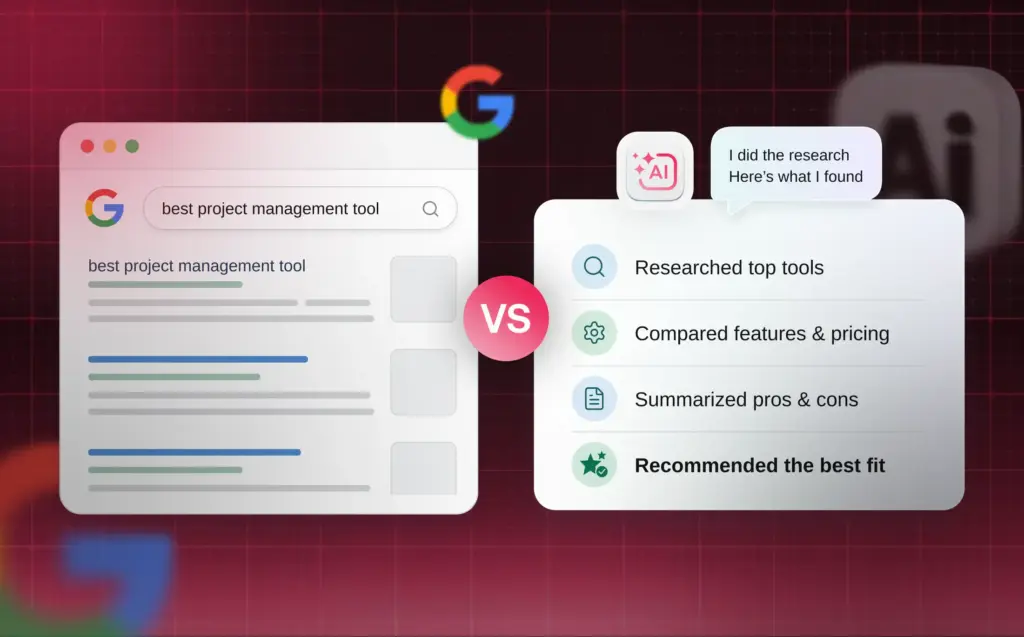
A few years back, Google was the only solution to all our queries. But this landscape has been extended with the emergence of AI search. So, AI search vs. Google search mainly comes to how information is found and presented.
Google mainly hands you a series of pages and lets you pick one based on your interests. On the other hand, ChatGPT, Perplexity, or Google’s own AI Mode writes the answer for you while offering a couple of sources. So, it’s the same question, but a different job is being done here. According to Search Engine Land, 37% of consumers now start their searches with AI tools instead of Google.
How Did Search Evolve from Keywords to AI Answers?
Early search engines were generally keyword-matching machines. You just had to type a word, and your screen will load pages containing that word and that’s it. But something smarter came into the picture with Google’s PageRank. It treated links between pages like votes of confidence. So, a page linked to by lots of other trusted pages ranked higher.
The next upgrade came with the emergence of semantic search. Google got better by understanding what you actually meant. For example, ‘budget laptops’ and ‘cheap good laptops’ started offering similar results, as Google could tell they meant almost the same thing. This is also when search engine optimisation moved away from exact-match keywords and towards search intent.
This led to the next shift: instead of only understanding the question better, why not answer it directly? So, in May 2025, Google went further with AI Mode, which offers a fully conversational search experience.
What Is Traditional Google Search and How Does It Work?
At its core, Google Search is a matching ranking system. It crawls billions of pages and finds what each one is about. So, when you search, it lists the pages that are more likely to answer your query. You can click through, read, and decide which one is better for you. In simple terms, it directs you towards the right bookshelf in the library but doesn’t read the book for you.
This model offers users more control over the discovery process. Therefore, you can compare multiple websites, check the original source, look at reviews and decide which information you should trust. Traditional Google search is viable when you already know what you are looking for, like:
- A product page
- A company’s website
- A local business
- A government website
However, AI Overviews are reshaping how users find or explore data on Google. The AI Mode is now in more than 200 countries and has a strong adoption rate in the first two markets it became available in.
How Does AI Search Work?
Most AI search tools use a method called retrieval-augmented generation (RAG). It sounds complicated, but it’s simple when broken down. First of all, the system retrieves a set of relevant pages using a search index. Further, it reads those pages and generates an answer in its own words.
The ‘retrieval’ part is why AI search still depends on the same underlying web that Google indexes. The ‘generation’ part is what makes it feel completely different to use. This is how you get a written and more focused answer instead of a series of links.
Other AI search experiences like ChatGPT and Perplexity also use conversational interfaces to help users research topics instead of simply presenting a conventional results page.
AI Search vs. Google Search: The Ultimate Differences
The table below compares AI search and Google Search across seven key factors.
| Factors | Google Search | AI Search |
| What you will get | A ranked list of links | One curated answer |
| Typical Query | Two to five words | Complete sentences, multi-part, with follow-ups |
| Unit that Competes | The page | The passage along with the brand entity |
| Dominant Intent | Navigational and transactional | Exploratory, comparative and advisory |
| Click Behaviour | Click expected | Click remains optional and is generally skipped |
| Source of authority | Backlinks and topical depth | Third-party mentions, citations, and clear authorship |
| How you measure it | Rankings, clicks, sessions, conversions | Citations, AI referral sessions and branded search lift |
Is AI Search Outperforming Google?
A generic search works effectively for searches like the definition of a word, tomorrow’s weather, etc. The answers remain straightforward and easily discoverable within the first few results. However, the limitations start appearing when your queries become complex or need a deeper understanding of a topic. For example, if you ask ‘what do I need to know to prepare for a marathon if I am over 40 with a focus on injury prevention?’ Google returns ten separate articles to compare. AI search returns one tailored plan covering training load, recovery and injury risk, with the sources cited.
A traditional search would recommend a series of reports, articles, and even academic papers. You need to spend hours trying to sift through stacks of data. For complex, multi-part questions, AI search often saves time compared with traditional search.
Because AI search interprets the intent behind a query, it doesn’t just present a list of links. Instead, it acts as your knowledgeable assistant. It analyses information from a wide array of sources to offer a direct and detailed answer. It can summarise complicated topics and compare different perspectives while generating creative content.
AI search traffic converts at 14.2%, as compared to Google’s 2.8. This is roughly 5x more valuable per session.
Conclusion
The key difference in AI search vs. Google Search is how information or data is delivered and how much of the research the technology does for the user. Traditional Google search puts more emphasis on discovering and comparing webpages. On the other hand, AI search can interpret detailed queries, combine information and offer a conversational answer.
But the two are increasingly converging. Google’s AI Overviews and AI Mode demonstrate that generative AI is now part of the Google Search experience itself. For businesses, the practical response is not to choose between SEO and AI search. It is to build well-structured and useful content that can be discovered through both.
If your business needs help with technical content, ecommerce development, web development and AI solutions, RVS Media is here to assist. We can help you build digital experiences and content around real business requirements.
Frequently Asked Questions
Not in any near-term sense. Google still manages the large majority of search volume. The thing that is changing is that it’s no longer the only place people look, and for specific kinds of questions, many people now prefer to start with AI search.
No, Google’s documentation states there are no additional requirements to appear in AI Overviews or AI Mode, and no special optimisations necessary. You need to prioritize more extractable structure, clearer authorship, and more original detail inside the strategy you already run.
It reduces clicks on simple informational queries, because the answer appears on the results page.


