
 AI
Development
AI
Development
 Shopify
 Magento Open Source
 Adobe Commerce
 WordPress
 B2B Excellence





How AI is Transforming the Manufacturing Industry in the UK?


Artificial Intelligence is changing the way factories and production lines work all over the world. The UK is part of this change. Companies are choosing more digital ways to do things. AI helps to make the work faster, easier, and brings in new ideas. In this blog, we look at how is AI transforming manufacturing industry, why it is important, and how companies can use these new tools to be ready for what comes next.
Introduction: Why AI Matters for UK Manufacturing
The entire UK manufacturing industry is going through a very big change. To name a few causes; the existence of numerous costs, scarcity of skilled workers, stiff competition from every part of the globe, and supply chain issues. Hence, it is a must for most companies to come up with entirely new methods of operations. The implementation of AI can be a good move to support such transformations. It is highly scalable, it can be adjusted according to diverse requirements, and it is capable of enhancing nearly all manufacturing processes.
UK factories can use AI in a number of ways, such as predicting problems, automating checks, using robots, and using IoT systems. These tools allow them to produce more, waste less, and create safer workplaces.
1. The Growing Importance of AI in UK Manufacturing
AI has gone from being tested to being a key part of how things work in production areas. Reports from the UK say using AI in manufacturing could bring billions more to the UK economy in the next few years. Some of the big reasons that people are starting to use AI include:
Technological Readiness
Advances in cloud computing, 5G, machine learning and robotics help more people and businesses use AI. Now, it is easier to get and grow these AI solutions than ever before.
Demand for Productivity and Automation
AI helps factories work better. It boosts uptime and cuts down on tasks that are done by hand or over and over.
Focus on Quality and Precision
AI-driven checks and data analytics help make sure the products be good and match strict rules. This helps customers be happy. It also makes the brand look good.
Sustainability and Waste Reduction
With AI, manufacturers can cut down on energy use, use fewer materials, and help reach their green production goals.
So, AI is now very important for factories in the UK. It is not just a new tool to use. People see it as something you must have to help plan and succeed.
2. Predictive maintenance: Cut down on stops and surprises
With the help of AI, the new century has found a completely different way of treating machines in the companies. The time when humans needed to check the machines either manually or by following a pre-described procedure seems to have passed. In its place, AI is here to predict the exact time that a particular machine will stop working and thus, the company can make its repairs in a timely manner.
How Predictive Maintenance Works
- Sensors pick up live data on things like vibration, temperature, and pressure.
- AI looks at the data to find patterns and things that do not fit.
- The system knows when a machine may break down. This helps people fix it early.
Benefits for UK Manufacturers
- Reduced downtime
- Extended equipment lifespan
- Lower maintenance costs
- Safer working environments
Predictive maintenance is very important in an industry where losing even a few minutes can cost a lot of money.
3. Robotics and Automation Powered by AI
Robots have been used in manufacturing for a while, but AI makes them much better. AI-powered robots can now:
- Change as conditions change
- Learn from what they’ve done before
- Work together with people
- Do hard or very exact jobs
Cobots (Collaborative Robots)
Cobots are becoming more popular in the UK because they can work with people safely. These robots can do the same things over and over. This helps workers spend their time on tasks that need more skill and planning.
Autonomous Robots
These robots can move on their own. They carry things, check goods, and do tasks without someone always watching them. This helps make work better for everyone.
Looking a technical partner to help grow your Business?
We Can Help!
4. Smart Factories and IIoT Integration
A big part of AI that is changing the manufacturing industry is the growth of smart factories. In these factories, the machines talk to each other. They do this by using the Industrial Internet of Things (IIoT).
Key Features of a Smart Factory
- Real-time data collection
- Automated workflows
- Self-optimising systems
- Continuous monitoring of assets
Benefits for the UK Manufacturing Sector
Smart factories help businesses watch how things are going, improve the way work gets done, and act fast when the market changes. The UK government gives strong support to digital change, so smart manufacturing will grow a lot over the next ten years.
5. AI for Quality Control and Defect Detection
Quality assurance is very important in making products. Now, with AI, people who make things can check their products in a better way. This is done by using computer vision and machine learning.
AI-Powered Quality Control
- Detects imperfections invisible to the human eye
- Inspects products at high speed
- Reduces error rates
- Improves customer satisfaction
UK manufacturers using AI quality checks are saying they have much less waste and better consistency across their production lines.
6. Supply Chain Optimisation Through AI
Supply chains are now harder to track and manage. AI helps us see patterns in all the data. It makes it easier to deal with changes and problems in the work. This lets people do things better and faster.
AI Improves:
- Demand forecasting
- Supplier risk assessments
- Logistics planning
AI also helps people in the UK factories see what’s happening in the supply chain. This makes it easier for UK manufacturers to act fast when there are problems. They can deal with problems like shortages, delays, or issues in other countries.
7. Enhancing Worker Safety Through AI
Safety is prioritized highly in production and the assistance of AI is greatly to lower risks. The intelligent devices monitor the environment and identify hazards, then they alert the personnel before any unfortunate incident occurs.
Examples of AI for Safety
- Keep an eye on equipment to see if it gets too hot or stops working.
- Seeing unsafe ways with computer vision
- Ensuring compliance with safety protocols
- Reducing exposure to hazardous materials
AI-powered safety systems help keep workers safe and lower the time lost from accidents.
8. Streamlining Product Design and Innovation
Artificial Intelligence is transforming the game in product manufacture; it now makes it possible for businesses to bring their thoughts to life much faster at the same time as saving them money.
Generative Design
AI systems can make thousands of design options based on input goals like how strong it is, the weight or how much it costs. Engineers pick the best model. This cuts down the time it takes to do the work by a lot.
Simulation and Testing
AI-powered simulations find weak spots in designs early. They help make sure products be up to quality before going into production.
The role of data in AI-driven manufacturing change
Data is the backbone of AI. There are many UK manufacturers who are putting money into strong data systems to help with new ideas.
Data Helps Manufacturers:
- Understand customer needs
- Improve operational performance
- Predict market trends
- Enhance decision-making
AI works with big sets of data. It finds things that people may not see by looking at the data on their own. When a maker gathers and looks at more data, the AI gets better and stronger.
Challenges Faced by UK Manufacturers in AI Adoption
While AI gives many good benefits, UK businesses still face some challenges.
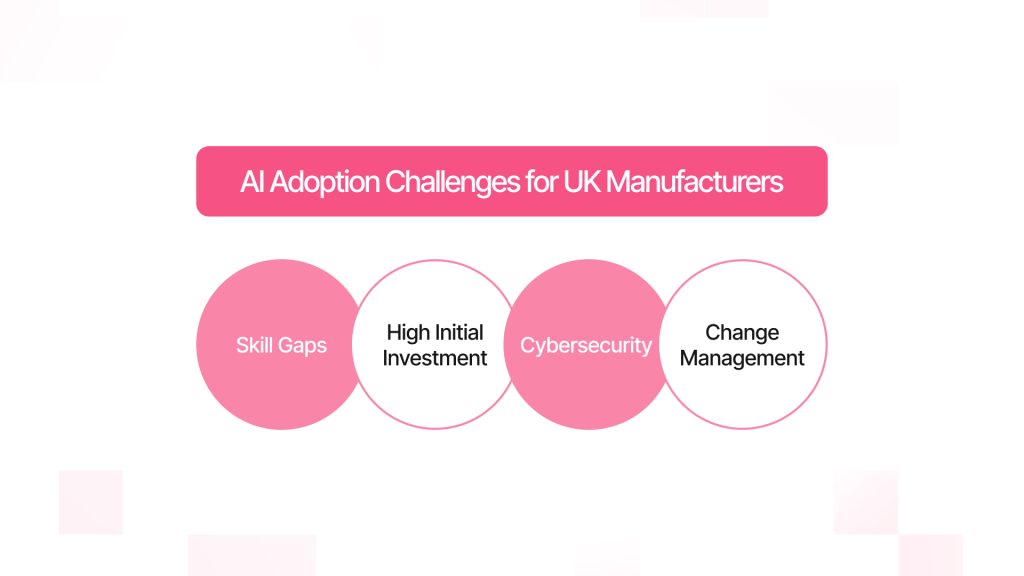
Skill Gaps
Manufacturers need more workers to learn about AI, robots and data.
High Initial Investments
AI integration needs you to pay in the beginning for things like tools and building blocks.
Cybersecurity Concerns
More connected systems can be easier to attack. This is why cybersecurity is so important now.
Change Management
Using AI can mean that there be changes in the way people work and act in a company.
These problems can make things hard. The good things you get from it are much bigger than the problems.
Future Trends: What’s Next for AI in the Manufacturing Industry?
People talk a lot about what the next big thing for AI will be in factories. This new tech will most likely change the way we make things even more. It can help us do work better, faster, and make less waste. Over time, new ways to use AI will show up. They may help us find new answers we have not thought about yet. Many look forward to what AI can do for all of us in the years to come.
The next ten years will have even smarter AI tools. Some of the main changes are:
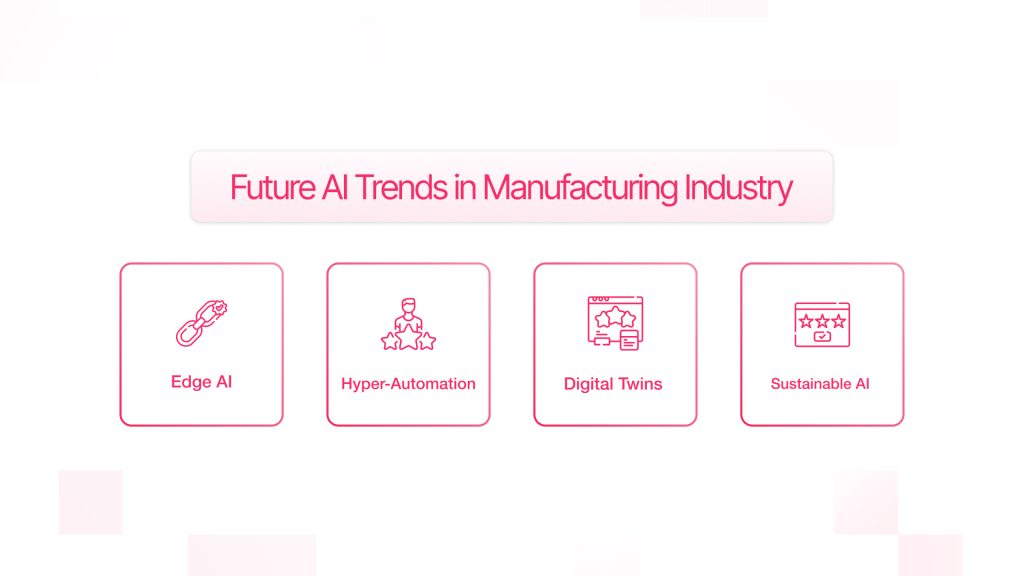
Edge AI
Using local data helps you get answers faster and make better choices.
Hyper-Automation
Bringing together different tech like AI, IoT, and RPA to build a system where everything runs on its own.
Digital Twins
Making virtual copies of real things to show how they work and to help improve how things are done.
Sustainable AI
Using smart systems to help with green manufacturing and circular economies.
The future of making things in the UK will be shaped by AI. Companies that start using AI soon will stay ahead of others.
How UK Manufacturers Can Start Their AI Journey
For makers who want to add AI to the way they work, here are the top things to do:
- Find the most important areas like maintenance, quality, and supply chain.
- Start out small with pilot projects before you move on to bigger tasks.
- Train workers.
- Build a solid data system.
- Prioritise cybersecurity and compliance.
- Work with people you trust for digital transformation.
Taking a clear and planned approach helps make AI easy to start using. It also leads to better results over time.
Exploring Digital Transformation for Your Business?
Our Experts Can Help!
Conclusion
The new technology in AI is not limited to factories only but is gradually spreading across the entire industry. The UK has resorted to changing its methods of doing things through the implementation of smart factories, predictive maintenance and advanced robots. These developments are time and resource savers. The manufacturing companies are already searching for the new methods that will provide them with enhanced production and operational efficiency. Using AI is becoming a must for those that want to do well for many years.
AI is starting to change the manufacturing industry. Makers who start using the new tools now will help lead the UK’s industry in the future.