
 AI
Development
AI
Development
 Shopify
 Magento Open Source
 Adobe Commerce
 WordPress
 B2B Excellence





Connecting Google Search Console to Social Media: Why It’s a Big Deal for Your Search Strategy
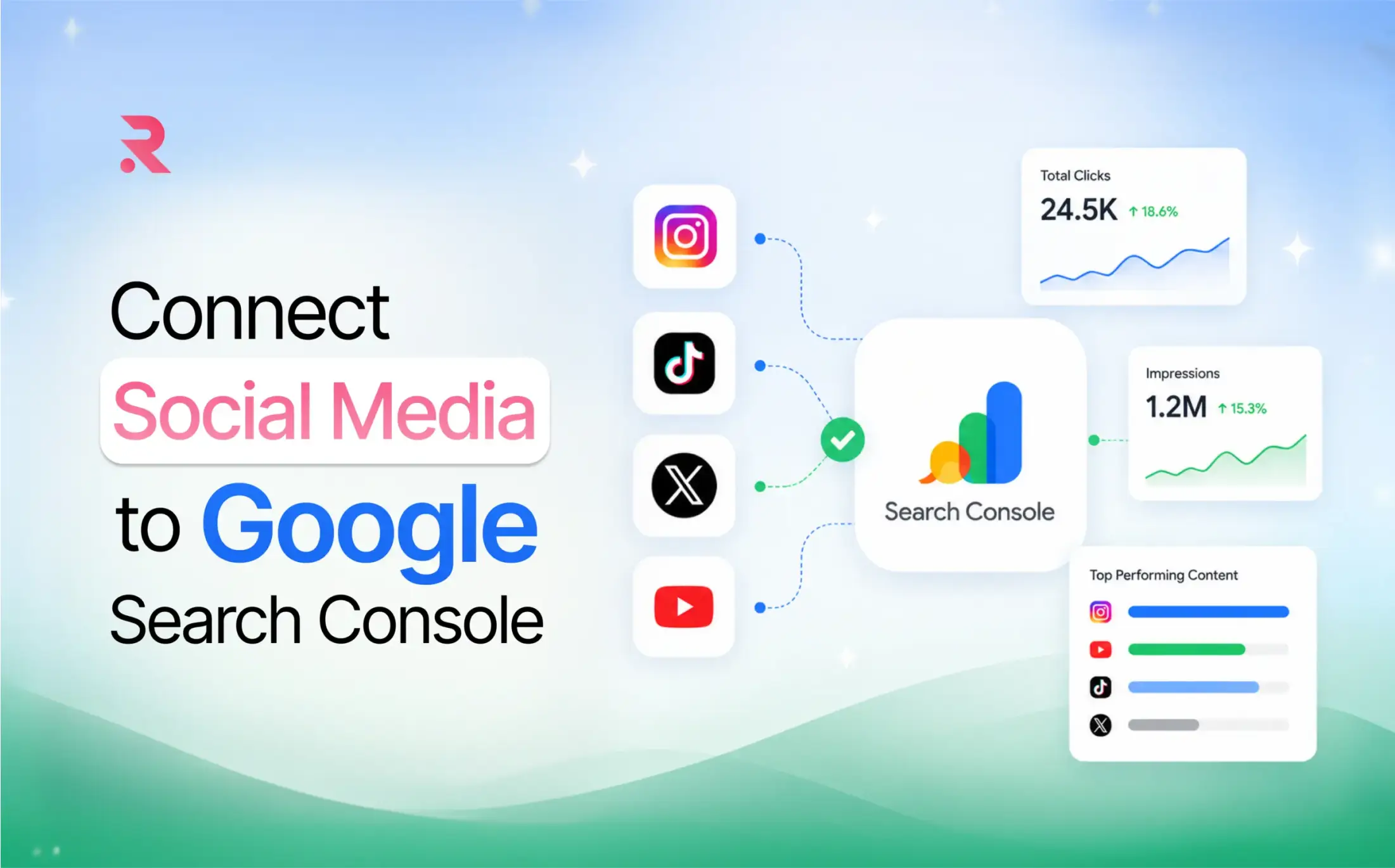


SEO teams and social media teams have traditionally been working from completely different data sets. One team is celebrating a viral Instagram Reel while the other wonders why organic traffic barely moved. Marketing meetings become a debate over which numbers matter because social engagement lives inside platform analytics, while search performance sits inside Google Search Console. The connection between the two has largely been based on assumptions rather than evidence.
Google Search Console now lets you add supported social media profiles directly to Search Console through Platform Properties, making it easier to understand how social content appears across Google Search and Discover. On 7 July 2026, Google rolled out Platform Properties in Google Search Console. Now, it’s possible to connect supported platform accounts directly to Search Console, without the need for a website. This isn’t a new ranking factor, but it is a major leap forward in reporting. Brands that invest in both SEO and social can now see more clearly than ever how their social content appears across Google Search and Google Discover.
What Are Platform Properties in Google Search Console?
Platform Properties are Google Search Console’s newest property type. They allow you to verify supported social media accounts as standalone properties, confirming ownership in much the same way website properties have traditionally been verified. Once verified, Search Console can report on how eligible content from those accounts appears across Google Search and Google Discover.
Rather than only verifying websites, users can connect selected social platforms to Search Console and see how content performs on Google.
The feature develops on Search Console’s existing capabilities to support the growing number of businesses and creators who share content on social media in addition to, or instead of, websites.
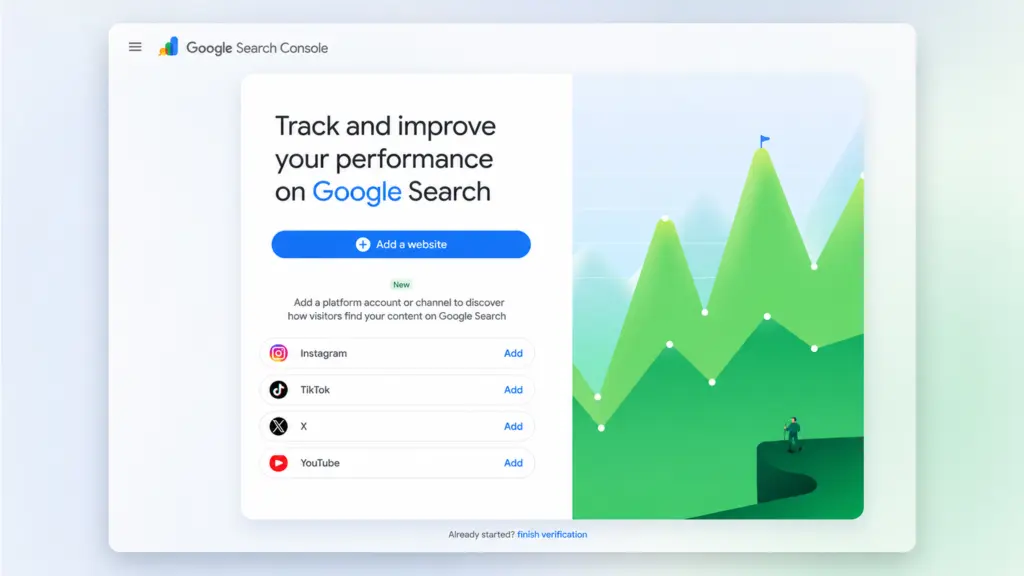
Platforms initially supported with standalone properties in Search Console:
- TikTok
- X (Twitter)
- YouTube
Until now, businesses had to use each social platform’s native analytics tools to review impressions, engagements, and audience behavior. Search Console only allowed users to monitor website traffic.
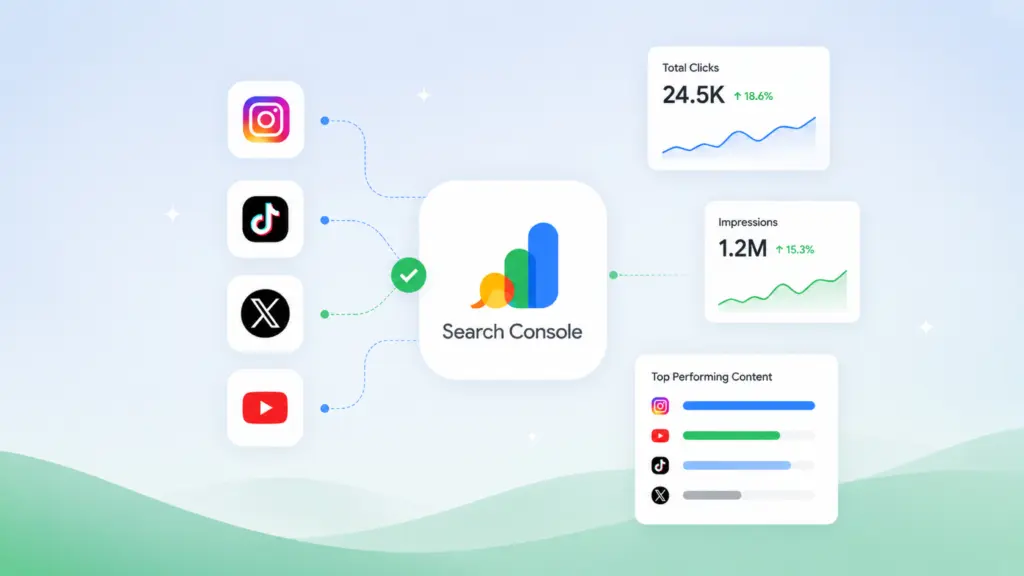
Platform properties connect these dots by showing users how designated social content is viewed on Google Search and Google Discover in the familiar Search Console dashboard.
Keep in mind, this doesn’t replace any existing tools like Instagram Insights, TikTok Analytics or YouTube Analytics. Those tools should still be used to monitor engagements. Google Search Console now allows you to see how your content performs on Google itself.
What Does This Update Mean for Search Strategy Today?
Say Goodbye to Siloed SEO and Social Data
Google Search is no longer the exclusive home for brands. Social content is everywhere today, and consumers increasingly discover it through Google Search or Google Discover without ever visiting a website.
Understanding that consumer journey has been remarkably difficult up until this point. A social team might know a TikTok went viral but have no visibility into whether it influenced Google searches later. On the flip side, an SEO manager may see increased branded Google searches without knowing which content generated that interest.
Until now.
These “platform properties” start to bridge that gap between SEO and social. Rather than operating in their own siloes, you can begin to see how one affects the other
Connecting Social Content to Search Visibility
Consider what this means for an ecommerce retailer. Running a product demo Reel on Instagram might now be able to be linked to an uptick in searches for that particular product. A restaurant might see a TikTok go viral and begin showing up in Discover right alongside more branded Google searches from hungry patrons. A B2B software company can now pinpoint which YouTube tutorials are driving the most search visibility for solution-related searches.
Armed with data like this, teams can make more informed decisions about their future strategy. Instead of having to guess which content is compelling enough to invest more resources in, teams gain valuable data points that highlight what types of content regularly show up in Google Search. And SEO teams can finally begin to quantify how social presence affects overall search visibility.
Platform Properties are another example of how Google Search continues to surface a wider range of content formats. From videos and creator content to short-form social posts, users increasingly discover information beyond traditional web pages. Search Console’s reporting is evolving to reflect that broader search experience.
This update to platform properties reflects that ideology by providing brands with reporting data that matches how people are actually searching in 2026.
The Biggest Benefits of Platform Properties
Unified reporting across search and social
Consolidating search visibility into one report is a massive benefit.
Instead of toggling between analytics dashboards, marketing teams can utilize Search Console to see how supported social content performs on Google Search.
This allows for more fruitful discussions between SEO specialists, content marketers and social media managers as they’re all operating from one source of truth.
No website required
The biggest change may be that you don’t need a website to use Search Console.
Creators, influencers and small businesses often grow their audiences on social platforms. They didn’t have much reason to use Search Console before.
Now that Search Console supports platform properties, you can use Google’s reporting tools whether you run your business entirely on Instagram, TikTok, YouTube or X.
Better query-level understanding
Search Console has been useful for a while because it allows us to see how users find content via search queries.
Platform Properties bring that same query-level visibility to supported social accounts.
Instead of just knowing how many views a video had, businesses can see additional data about how their social content is showing up throughout Google.
If you’re a marketer that cares about search intent, it’s even more useful than just engagement data.
Stronger collaboration between SEO and content teams
Platform Properties also make it easier to manage social channels in Search Console alongside your website properties, giving marketing teams a more complete reporting workflow.
As a result, teams tend to duplicate work, deliver inconsistent reporting and miss opportunities.
Platform Properties help bring SEO and social teams together by giving both access to complementary search performance data within Google Search Console.
Rather than arguing over which channel gets credit, businesses can now see how SEO and social work together to drive discovery.
How to Connect a Social Media Account to Google Search Console
If you’re wondering how to add social media to Google Search Console, Google has introduced Platform Properties to make the process straightforward. The verification steps are like adding a traditional website property.
- Open Google Search Console.
- Select the Property Selector.
- Choose Add Property.
- Select the new Platform Property option.
- Choose the supported platform you want to connect.
- Complete the verification process.
- Wait for Search Console to begin collecting and displaying data.
Since Google is slowly releasing support for this feature, some people might not see the option for a platform property just yet.
After it appears, data can also take time to appear after you’ve successfully verified.
Want to Improve Your Organic Search Performance?
Our Experts Can Help!
What This Means for SEO Professionals
SEO professionals will likely find platform properties less of a replacement and more of an enhancement to their existing analytics.
Google SEO has never been only about getting web pages to rank.
Effective search engine strategies involve video, short-form content, learning resources, creator relationships, and brand presence across every channel available.
This new update will make it easier to see how those efforts overlap within Google’s search ecosystem.
Plus, it prompts analysts and marketers alike to look at the forest instead of the trees.
Rather than benchmarking Instagram performance by likes or TikTok performance by views, marketers can start asking better questions.
- What content drives branded searches?
- What videos are repeatedly showing up in Google Discover?
- What topics are gaining visibility outside of the platform?
The answers to questions like these allow for better long-term planning when it comes to content strategy.
Search Console might not be able to provide all of the answers by itself, but platform properties are a great start.
How RVS Media Turns Search Console Data Into Strategy
Search data is useless if you don’t know what to do with it.
We convert search data into actionable growth at RVS Media with thoughtful SEO strategy, content planning and technical optimisation. With each update Google rolls out to Search Console, it’s becoming increasingly important to know not just how to collect data, but also how to interpret it.
Our SEO consultants can help you spot opportunities in your Search Console reports, better align your content plans with real user search behaviour, and optimise your website to handle traffic from search (and social). We also provide in-depth performance audits to identify technical issues that could be hurting your site’s visibility, UX or conversion rates.
Whether you’re trying to make sense of Google’s latest Search Console update or just looking to level up your overall organic strategy, it can be difficult to know where to start. Let us help you focus on what matters.
Looking for a Professional SEO Audit?
Our Experts Can Help!
What Platform Properties Don’t Do
Just because we’re excited about platform properties doesn’t mean we can’t separate fact from fiction.
Will Platform Properties Boost My Rankings?
Not necessarily. Here’s what we do know about platform properties:
First, access is still rolling out, so the option may not appear in your account yet.
Second, Google has made no indication that verifying a platform property will offer any kind of ranking benefit. We know this feature is about reporting, not ranking.
In fact, take advantage of these tools to gather as much data as possible about your performance so you can learn and improve.
Platform properties are not a shortcut to SEO success. Think of them as another pillar of information you can use to make smarter decisions for your business.
That said, don’t abandon your native analytics just because you’ve verified a Platform Property. Instagram Insights, TikTok Analytics and YouTube Analytics remain essential.
At RVS Media, we believe the most powerful reporting comes from combining data from both your native analytics platform and Google Search Console.
Stay Ahead of Search Changes
Google’s introduction of Platform Properties reflects a broader shift in how people discover content online. Valuable content no longer lives solely on websites. It also exists on platforms like YouTube, Instagram, TikTok and X, where users increasingly begin their search journeys. By bringing supported social accounts into Google Search Console, businesses gain a clearer view of how their search and social efforts work together.
While Platform Properties won’t improve rankings on their own, they provide reliable reporting that can help marketers make more informed decisions about content, visibility and audience engagement.
If you’re looking to turn those insights into measurable growth, RVS Media’s SEO specialists can help you interpret Search Console data, strengthen your content strategy and optimise your website for long-term organic success.
Frequently Asked Questions
No. One of the biggest changes introduced with platform properties is that supported social media accounts can now be verified independently, even without an associated website.
Yes. Google currently supports Instagram, TikTok, X and YouTube through Platform Properties. If you’re looking for how to add Instagram to Google Search Console, simply create a new Platform Property, complete verification and wait for reporting data to appear.
No. Platform Properties don’t replace Instagram Insights, TikTok Analytics or YouTube Analytics. Search Console reports how eligible social content appears in Google Search and Google Discover rather than tracking views or engagement on the social platform itself.
Once you verify a property, Search Console might take time to show performance data. Since this feature is being rolled out gradually, times will vary.
Zero clicks don’t necessarily indicate a problem. Newly verified Platform Properties can take time to display data, and Search Console only reports clicks from eligible content that appears in Google Search or Google Discover. Since the feature is still rolling out, availability and reporting may vary between accounts.
No. At launch, Google supports Instagram, TikTok, X and YouTube. Facebook isn’t currently listed as a supported Platform Property.