 AI
Development
AI
Development
 Shopify
 Magento Open Source
 Adobe Commerce
 WordPress
 B2B Excellence





How to Start an Online Store in the UK? (2026 Step-by-Step Guide)
To start an online store, you need a viable product, a business model, a chosen ecommerce platform (Shopify, WooCommerce, BigCommerce or Adobe Commerce), a payment and fulfilment setup, and a marketing plan. Most UK stores can launch in 4–6 weeks. Below is the full step-by-step process.
- September 2, 2026
- by Tarun
What does it take to start an online store?
Starting an online store takes more than putting products on a website. You need a well-defined business model, consistent branding, the right ecommerce platform and software, a secure buying journey and marketing campaigns that will drive customers to your store.
The UK remains a significant ecommerce market. According to the ONS, online sales made up 27.4% of total UK retail sales in 2025, rising to 28.3% in June 2026 (ONS Retail Sales, last checked August 2026).
If you are wondering how to start an ecommerce business, this guide covers the practical steps we recommend before investing heavily in your store.
To start an online store, you need a viable product or service, a clear business strategy, a recognisable brand, a suitable ecommerce platform, reliable payment and fulfilment processes, and a plan for attracting customers. The technology is important, but your product, positioning and customer experience ultimately determine whether the business can grow.


Are You Ready to Start an Online Store? 3 Signs You Are
It may seem easy to put up an online shop. Get a website, add products and start selling.
There are commercial and technical decisions behind every successful ecommerce store.
You may be ready to start if:
1. You are very interested in running an ecommerce business
You need to be committed to the process. Running an online store involves much more than website management. You will need to understand customers, competitors, pricing, fulfilment, returns and marketing.
Research your market before investing heavily in the website. This gives you a clearer understanding of what running the business will involve.
2. Do You Need Technical Skills to Run an Ecommerce Store?
You do not need to become a developer, but you should understand how your chosen platform handles products, orders, payments, promotions, customers and reporting.
There will be a learning curve, particularly if ecommerce is new to you.
3. You have good products to sell
A strong ecommerce website development cannot compensate for a weak product proposition.
Before worrying about themes and plugins, make sure you understand what you are selling, who needs it and why customers should choose it over alternatives.
How to Set Up an Online Store in 5 Steps
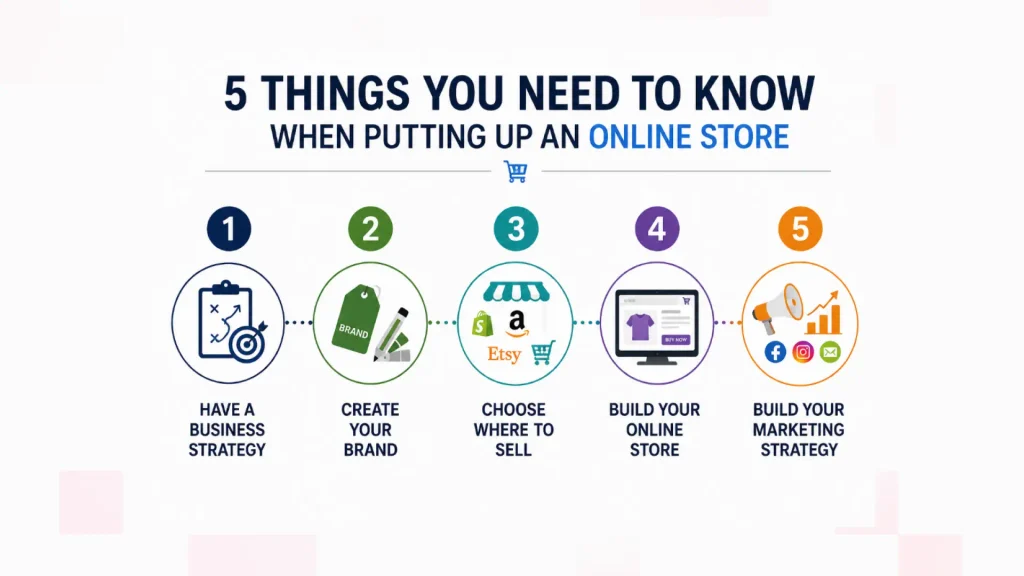
1. Choose Your Business Model
Choose your business model first: dropshipping, wholesaling, white labelling or print on demand. Each one changes your margins, stock risk and fulfilment time, so pick before you buy a platform.
Some common ecommerce models are:
- Dropshipping: Ordering products from a supplier after a customer purchases them. Fulfilment is typically managed by the supplier.
- Wholesaling: You purchase products in bulk and hold stock for resale.
- White labelling: A third party manufactures your product that you sell under your own brand.
- Print on demand: Products are produced or printed when customers place orders, reducing the need to hold finished stock.
Margins, inventory, fulfilment and the overall customer experience will vary depending on your chosen model.
Choose the approach that fits your products, resources and commercial goals rather than simply choosing the model with the lowest upfront commitment.
2. Build Your Brand Identity
Ecommerce customers have plenty of alternatives, so your brand needs to be memorable.
Your logo, colours, typography, imagery, product photography and messaging should work together to create a consistent experience.
Look at competitors to understand the market but avoid copying them. If every brand looks and sounds the same, differentiation becomes much harder.
3. Should You Sell on Your Own Website or a Marketplace?
You can sell through your own website, marketplaces such as Amazon and Etsy, social commerce channels, or a combination of these.
Your own website gives you greater control over branding and the customer journey. Marketplaces can offer more reach, but they have their own rules, fees and policies.
Select an online store builder for your primary store that meets your current needs and allows for your future growth.
Shopify’s UK Basic plan is currently listed at £25 per month when paid monthly or £19 per month when paid yearly. BigCommerce’s Core plan is listed at £39 per month (or approx. £29 per month billed annually). WooCommerce’s core platform is free, although hosting, extensions and development create additional costs. Adobe Commerce uses customised pricing.
The right platform depends on your catalogue, integrations, B2B requirements, international plans, customisation needs and available technical resources.
At RVS Media, we work with Shopify, WooCommerce, BigCommerce and Adobe Commerce because different businesses need different ecommerce architectures.
4. Build Your Online Store
Once you have chosen your platform, build the store around your customer.
Your design should reflect your brand, but visual appeal is only one part of the process.
Make sure the store works properly across mobile and desktop devices. Navigation, product pages, filters, variants, cart functionality and checkout should all be tested before launch.
Consider your payment options. Stripe, PayPal and other big providers are still popular, however services like Klarna and Clearpay may also be appropriate for UK ecommerce stores. Keep in mind that not all payment methods will be available to every business, this can depend on the platform, payment provider and the merchant.
Set up your shipping and returns policy ahead of launch. Clear information should be provided about delivery costs, shipping areas, fulfilment times and your returns policy.
Most importantly, your product pages should answer customer questions. Include useful descriptions, specifications, images, availability, delivery information and relevant FAQs.
Why Technical SEO Matters Before You Launch
Writing keyword-rich copy is only one part of ecommerce SEO.
Your store needs to be built on strong technical foundations too. Mobile responsiveness, page performance, crawlability, internal linking and structured data are all important.
Technical SEO matters to both audiences: shoppers abandon pages that load in over 3 seconds, and search engines cannot rank pages they cannot crawl or parse.
We’ve learnt time and time again from our ecommerce clients that migrations are about a lot more than moving product data from one store to another. URL structures can change, metadata can be lost, performance can suffer, user experience can be impacted, integrations can break and organic visibility can be affected.
That’s why it’s best to address these things before launch.
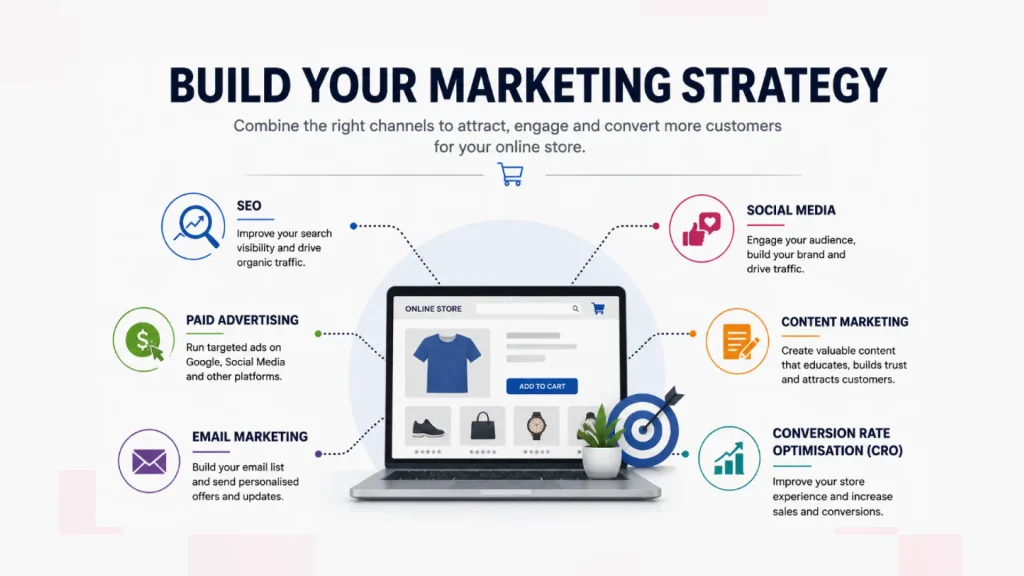
5. Build Your Marketing Strategy
Launching the store is only the beginning.
Before spending money on advertising, understand where your customers actually spend their time. Depending on the business, this could include Google, social media, marketplaces, email or industry-specific channels.
Do not assume there is one universal advertising budget. The right amount depends on your margins, average order value, customer acquisition cost and available cash flow.
Start with a controlled test budget, measure performance and increase investment when the numbers justify it.
Your digital marketing strategy can include:
- SEO
- Paid advertising
- Email marketing
- Social media
- Content marketing
- Conversion rate optimisation
- Marketplace marketing
A strong ecommerce business connects these channels rather than treating them as isolated activities.
Need a reliable digital marketing partner to help grow your Business?
Our Experts Can Help!
What Are the Biggest Challenges of Running an Online Store?
Starting an online store can be exciting, but it is important to understand the challenges.
- Competition: A professional website does not automatically create demand. You still need a strong product, clear positioning and effective marketing.
- Cash flow: Revenue is not the same as profit. Stock, fulfilment, advertising, returns and technology costs can all affect cash flow.
- Returns: Returning goods are standard in ecommerce. GOV.UK explains that consumers usually have a right to cancel within 14 days of making eligible online purchases.
- Operational complexity: A lean store grows in complexity as you add more products, warehouses, integrations, countries or sales channels.
Build with growth in mind, but don’t pay for unnecessary complexity.
What Do You Need to Launch an Online Store Successfully?
Launching an online store is not just putting products up on the web and hoping people buy them.
Launching successfully means four things: building a business around a strong product, creating a memorable brand, choosing technology that fits your goals, and making checkout as simple as possible.
The potential is enormous. But success lies in nailing the basics.
If you are planning to start an ecommerce business in the UK and need help choosing a platform, planning your ecommerce architecture or building your store, RVS Media can help.
There is no fixed cost. Your investment depends on the ecommerce platform, hosting, design, development, payment processing, apps and marketing required. Shopify’s UK Basic plan currently starts at £25 per month when paid monthly, while WooCommerce has no core platform subscription but requires hosting and potentially paid extensions.
There is no one-size-fits-all solution. Shopify works well if you prefer a hosted platform. WooCommerce is great if you like open-source flexibility. BigCommerce includes more built-in ecommerce features out of the box, such as multi-currency and faceted search, reducing app dependency. Adobe Commerce is ideal for larger, more complex businesses. The best platform for you depends on your products, desired integrations, customers, budget and future goals.
There is no general licence required simply because you sell online. However, certain products and activities require specific licences, registrations or permits. You should check GOV.UK requirements for your business before trading, particularly if you sell regulated products or import goods.
There is no universal timeline. A straightforward store using an established platform and theme can launch relatively quickly, while custom development, migrations, integrations and complex catalogues require more planning. At RVS Media, our Shopify Ecommerce Accelerator can target a four-to-six-week route to launch for suitable projects, although requirements vary.
Not necessarily. You can operate as a sole trader without forming a limited company, although you may need to register for Self Assessment depending on your circumstances. A limited company must be registered before it starts trading. GOV.UK provides current guidance on choosing and registering a business structure.
When you sell on your own website, you have more control over your brand, customer experience and merchandising. Marketplaces allow you to tap into existing audiences, but you must do it on their terms and with their commercial conditions. Many ecommerce brands sell both on their own website as well as on marketplaces. Think of your own website as your ecommerce storefront, where you control the branding and experience, and marketplaces as another channel for distribution.
There is no one-size-fits-all marketing budget for ecommerce. Your budget needs to be based on your margins, average order value, customer acquisition cost and cash flow. Begin with a manageable test budget. Measure performance and scale up when your acquisition and conversion metrics prove that it makes commercial sense to spend more.