 AI
Development
AI
Development
 Shopify
 Magento Open Source
 Adobe Commerce
 WordPress
 B2B Excellence





Amazon Ads vs. Google Shopping: Which Platform Is Right for Your Ecommerce Business?


Pick Amazon Ads if most of your sales already happen on Amazon and you want fast purchases.
Pick Google Shopping if you sell on your own site and want to own the customer. You can have a good product, a healthy margin and a sensible PPC budget, and still waste money in the wrong place.
That is the real issue behind Amazon Ads vs Google Shopping. Amazon puts you in front of people already shopping. Google can capture demand before that shopper has decided where to buy. The right choice depends on where your customers are in their buying journey, where the transaction happens and how much control you need over the customer relationship.
Here is how we would approach that decision when assessing an ecommerce PPC strategy.
What Are Amazon Ads and Google Shopping Ads?
Amazon Ads are paid placements within Amazon and, depending on the campaign type, beyond Amazon. Sponsored Products are the most familiar format, placing individual products in shopping results and on product pages. They operate primarily on a CPC auction model.
Google Shopping ads use product information from Google Merchant Centre to show shoppers an image, product name, price and retailer before they click. They can send the shopper directly to your ecommerce website.
The distinction sounds simple, but it changes the economics.
Amazon often captures existing marketplace demand. Google can capture demand for the product itself, the problem it solves or the brand selling it.
What Are the Key Differences Between Amazon Ads and Google Shopping?
| Factor | Amazon Ads | Google Shopping |
| Audience intent | High. Most Amazon users are ready to buy. | Mixed. Covers both research and buying. |
| Buying environment | Amazon marketplace | Your website or Google ecosystem |
| Buyer readiness | Often close to purchase | Can range from research to purchase |
| Main advantage | Marketplace conversion intent | Reach and customer ownership |
| Product discovery | Within Amazon | Across Google Search and Shopping |
| Ad formats | Sponsored Products, Sponsored Brands, Display and more | Shopping, Performance Max and other Google formats |
| Data/control | Strong marketplace data, but Amazon owns the customer relationship | Greater control over website experience and first-party data |
In account audits, one of the biggest mistakes we see is judging both platforms purely by ROAS.
A £5,000 Amazon campaign producing £20,000 in attributed sales looks attractive. But if Amazon fees, marketplace margins and customer ownership are different from your DTC model, that £20,000 does not necessarily have the same business value as £20,000 generated through your own store.
What Is the Difference Between Google Shopping Ads and Performance Max?
Shopping ads only run on Shopping inventory. Performance Max runs across Search, Shopping, YouTube, Display, Discover, Gmail and Maps, and Google’s AI picks where the budget goes.
For many ecommerce businesses, Performance Max is now the starting point rather than a simple alternative to Shopping.
Google has also introduced AI Max for Shopping, which expands Shopping campaigns towards more conversational and research-led searches while retaining Shopping controls. Google says its internal 2026 data shows advertisers activating AI Max for Shopping typically saw around 5% more conversions or conversion value at a similar CPA or ROAS, although that is Google’s global internal data rather than a UK benchmark.
The practical decision is therefore:
- Use Standard Shopping when you need tighter product-level control and testing.
- Consider Performance Max when you have sufficient conversion data and want Google to find demand across multiple channels.
- Test rather than assume. Google itself provides experiments for comparing Standard Shopping and Performance Max.
Google Shopping Ads Cost vs. Amazon Ads Cost
There is no single average CPC for either platform. UK Google Ads CPCs sit close to £1.28 on average, while Amazon Sponsored Products CPCs swing a lot by category, so your own numbers matter more than any benchmark.
Another 2026 UK ecommerce dataset reported a £0.41 median Shopping CPC, demonstrating exactly why headline benchmarks need context. Different datasets, campaign mixes and product categories produce very different numbers.
A 2025 UK benchmark by put the average Sponsored Products CPC at about £0.56 (roughly $0.71).
Amazon’s own 2026 benchmarking tools are more useful because advertisers can compare CPC, ROAS and other metrics against category peers in the UK marketplace.
For budgeting, start with unit economics rather than a platform average:
Maximum CPC = average order value × conversion rate × target ad cost percentage. Example: £60 × 3% × 10% = £0.18 max CPC
Then adjust for gross margin, returns, fulfilment, marketplace fees and customer lifetime value.
That tells you far more than saying, “Amazon is cheaper” or “Google converts better.”
Which Platform Is Right for Your Business?
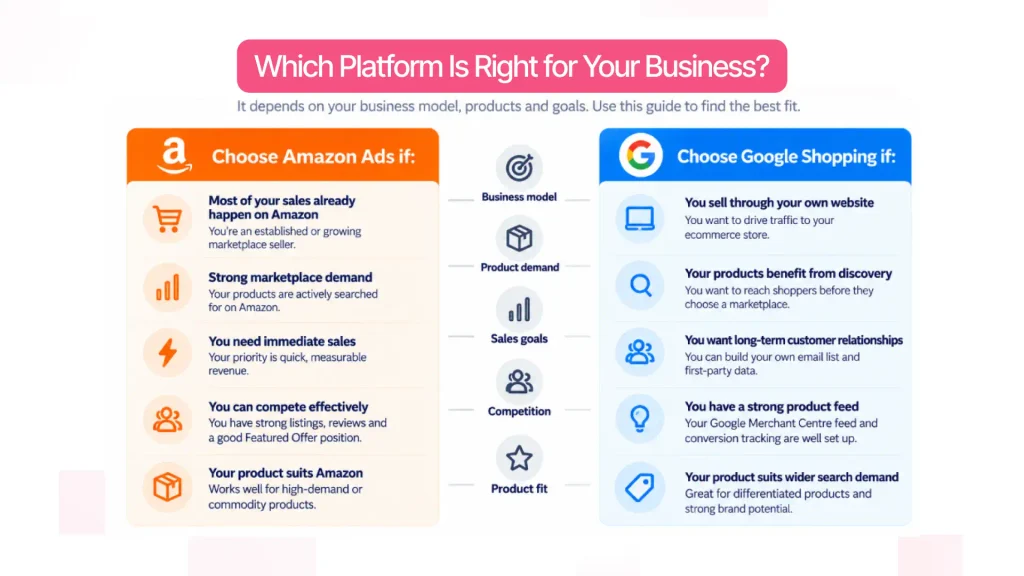
Choose Amazon first if:
- Most of your sales already happen on Amazon.
- Your products have strong marketplace demand.
- You are competing heavily for Amazon search terms.
- Priority is immediate product sales.
- Your listings, reviews and Featured Offer position are strong.
Amazon is particularly powerful when shoppers already know what they want.
Choose Google first if:
- You sell primarily through your own ecommerce website.
- You want to build long-term customer relationships.
- Products benefit from brand discovery.
- You need to reach shoppers before they choose a marketplace.
- You have a strong Merchant Centre feed and conversion tracking setup.
Google also gives you more opportunities to build a journey around the purchase rather than simply winning a marketplace listing.
Products matter here too. Running ads for a commodity product competing with dozens (hundreds?) of others on Amazon is going to look very different than pushing branded demand for a differentiated product.
Can You Run Both?
Yes, and in many cases that is the right answer.
Think of Amazon and Google as two doors leading into the same store. Amazon is great at capturing shoppers who are already looking around in the store. Google is great at leading potential customers to those exact same aisles.
A sensible combined strategy might look like this:
- Use Amazon Ads to defend high-value marketplace searches.
- Use Google Shopping or Performance Max to drive profitable traffic to your own store.
- Separate brand and non-brand performance where possible.
- Compare profit, not just platform ROAS.
- Track new customers, repeat purchase rate and contribution margin.
- Shift budget according to marginal profitability, not whichever platform has the prettiest dashboard.
This is especially important because Google and Amazon attribution are not directly comparable. Each platform measures conversions through its own attribution system, so a 4x Amazon ROAS and a 4x Google ROAS should not automatically be treated as equal outcomes.
FAQs
Neither one is better overall. Amazon Ads win when shoppers are ready to buy on Amazon. Google Shopping wins when you want traffic to your own site.
Neither platform is consistently cheaper. Amazon Sponsored Products and Google Shopping both use auction-based pricing, so CPC varies by category, competition, targeting and conversion performance. Current UK benchmarks show substantial variation, making your own profitable CPC and contribution margin more useful than a generic platform average.
Amazon Ads primarily reach shoppers within Amazon’s marketplace, while Google Ads can reach shoppers across Google Search, Shopping, YouTube, Display, Discover, Gmail and Maps. Amazon is often closer to the transaction; Google provides broader opportunities to capture product and category demand.
Performance Max is generally worth testing when an ecommerce brand has reliable conversion tracking, sufficient product data and a clear sales objective. Standard Shopping can still be useful when tighter product-level control is important. Google now also offers AI Max for Shopping, expanding Shopping towards more conversational searches.
There is no universal good Amazon ROAS. You can have a 3x ROAS ratio be profitable on one product and not profitable on another product. That is because gross margin isn’t consistent across products due to varying Amazon fees, fulfilment costs and returns. Use your target from contribution margin and break-even ACOS to measure performance against Amazon benchmarks for your category.
Yes. They can work together very well for a powerful multi-channel strategy if each channel has its place. Amazon can soak up marketplace purchase intent, and Google can drive traffic to your own store and help you build direct customers. Allocate budget based on incremental profit, not just whichever channel shows the higher ROAS.